

Crossfields of Arnside were leading builders of Morecambe Bay Prawners and yachts from the 1840s to the 1940s. They were probably the biggest builders of yachts and inshore fishing boats in the North West, despite being a relatively small village boatyard. They designed and built many of the North West leading yachts in the period 1900 to 1940, Whilst nearly all of their boats were built for North West market by the 1930s Crossfield boats could be on the East and South Coasts. By 2000 there were two Crossfield boats in the Mediterranean and one in America

William Crossfield and workforce, Beach Walk, Arnside
Historical Context
Arnside is located on the Kent Estuary south of Kendal. As in any coastal location there would have demand boats which for would have been met a small local business, such as the village joiner. Arnside would have been a remote coastal village surrounded by marshes, approached by a tidal road along the sands from Milnthorpe. Unlike most other places on the North West Coast Arnside is wooded, providing a local source of timber to build boats.
The estuary acted as the port for Kendal with boats unloading at Sandside and Milnthorpe with a customs office at Arnside. There is some evidence that ships were built and repaired at Milnthorpe and Arnside. In 1731 the Mary built in Milnthorpe was recorded in Barbados. There are records of the Leighton, a sloop, being built in Arnside for Backbarrow Iron Company in 1715.
Rich Victorians built houses on the estuary with the village’s first yacht club founded in 1852, creating a local demand for yachts. Bonita (1888) is example of a boat built for a rich Victorian who had a house on the estuary. In Bonita’s case Edwin Wrigley a Bury paper manufacturer who owned Holme Island.
Arnside developed as a select resort with the opening of the railway in 1858. Visitors then as now were attracted by the beautiful scenery and the estuarial location. Arnside became a centre for water borne recreation with annual regattas, which included both sailing and rowing, creating a demand for boats. Crossfields hired boats to holiday makers.

Boat trip 1912, Arnside with Fred Crossfield rowing
From 1890s Crossfield started supplying yachts to a wider North West market. The development of yachting and yacht clubs created a demand for yachts from the rich. The Royal Mersey was established in 1844, West Lancashire (Southport) in 1894 and perhaps more significantly for Crossfields, Blackpool and Fleetwood Yacht Club in 1906. Yachts also became smaller no longer requiring large crews, enabling boatyards located on shallow estuaries like Arnside to compete. Boats built by Crossfields for the rich Lancastrians include Laura (1908) and Moya (1910), both of which were kept at Blackpool and Fleetwood Yacht Club. In Barrow there is some evidence that professional boatmen, such as pilots and ferrymen brought yachts to race for money. Ploughboy (1902) is an example of this type of boat.
Crossfields are best known for Morecambe Bay Prawners. The demand for Morecambe Bay Prawners and fishing boats was fuelled by the growth of the industrial towns of the North West and by the railways. Railways meant that a perishable catch could be transported from the coast to the growing industrial towns of the North providing an affordable food. By the 1900s there were fleets of around 100 prawners at Fleetwood, Morecambe and Southport, many of which were built by Crossfields.
Wakes Weeks, when all the mills in a town closed down for a week and everyone went on holiday, led to the growth of seaside resorts creating a market for boats to take holidaymakers out on the sea. Crossfields supplied Bay Boats, which took holiday makers from Morecambe to Grange and Arnside.
The growth in maritime activity led to demand for other types of boats such as pilot boats and lifeboats.
History of Crossfield Boatbuilders
John Crossfield 1782 – 1864
The first Crossfield to move to Arnside was John, who set up a village joinery business in the early nineteenth century.
Francis Crossfield 1811 – 1899
His younger son Francis developed the boat building side of the business, launching his first boat in 1838, whilst his elder brother Thomas concentrated on house building. Many coastal villages at the time would have had joinery / boat building businesses that supplied boats to the local market.
Crossfield Brothers, Top Shop, Church Hill
By the mid-1880s the business was being run by his sons William, Francis, John and George as Crossfield Brothers operating from the Top Shop yard on Church Hill opposite Arnside EI. Boats were rolled down the hill to the shore and launched from the beach. The Top Shop Boat Yard was redeveloped as housing in 2019. Up till the 2000s it was used by a joinery business.
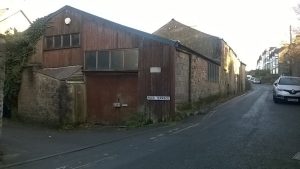
Top Shop outside view 2017

Top Shop interior 2017
William Crossfield and Sons, Beach Walk
In 1892 William, the eldest son, set up the Beach Walk Boatyard on the shore operating as William Crossfield and Sons taking his brother Francis with him. His sons Frederick and William Junior continued to operate the Beach Walk boatyard till the 1940s, though demand for yachts and prawners declined after the First World War. There is a model of the boatyard in Lancaster Maritime Museum.

Early photo Beach Walk Boatyard
Crossfield Brothers (John and George)
The Top Shop Boatyard was run as Crossfield Brothers run by William’s half-brothers John and George from 1892 to 1906.

John Crossfield, Conway
In 1906 John moved to Conway opening a boat building business there that lasted till 1983. His boatyard was on Conwy Quay just outside the town walls close to the Castle.
George Crossfield and Sons
The Top Shop boatyard was then run by his younger brother George as George Crossfield and Sons. When George died in 1909 the name reverted to Crossfield Brothers run by his sons, George and Herbert.
Crossfield Brothers, Hoylake
In 1915, George and Herbert moved to Hoylake in the Wirral, the business lasting till the early 20s.
Crossfield Successors
When Frederick, the last of the Crossfields retired, the Beach Walk Boatyard was run as Crossfields Successors, firstly by John Gill till 1966 and then John Duerden till 1983. The yard finally closed in the mid-1980s. The building has been unused ever since. Crossfield Successors made 13 of the West Kirby Hilbre Class. They acted as Yacht Chandlers, maintained moorings in the estuary and provided boat storage in the adjacent quarry. John Duerden was instrumental in setting up the Arnside Coastguard Station. John Gill moved to Aldeburgh, setting up a boat building business there, which is now owned by Demon Yachts.

Beach Walk Boatyard 1950s or 60s
Other Crossfield Businesses
Another family branch built many of Arnside’s houses. James Crossfield had a grocery store, now a café-bar
BBC Villages by Sea
William Crossfield and Sons’ Beach Walk Boatyard and Arnside Sailing Club’s Severn featured in a BBC Village by the Sea programme about Arnside in 2021

Filming Severn in 2021 for BBC Villages by the Sea
Ernest Caisley Arnside Cabinetmaker 1900s to 1915

Ernest Caisley was a cabinet maker based in Arnside, who was involved in fitting out the interior of yachts, including Moya and providing furniture for many of Arnside’s large houses, which would have new then. He was trained by Gillows in Lancaster. His workshop must have been large as it employed a foreman, polishers, cabinetmakers and upholsterers. Moya’s interior featured in a Yachting World Article in 1910.
His company went onto liquidation in 1915 perhaps as there was not the demand for fitting out yachts and luxury furniture.
After the war he set up a firm in Bristol living in a house called “Silverdale”.

Moya Original Interior 1910
Historical Significance of Crossfield Boatbuilders
Crossfields were leading builders of Morecambe Bay Prawners (or Lancashire Nobbies), a regionally significant type of fishing boat used in the Irish Sea between North Wales and Southern Scotland. They advanced design of the boat.
Based on the number boats recorded in Lloyds Register of Yachts, they were probably the biggest builders of yachts in the North West in the early twentieth century. The 1930 Register records 40 yachts built by the two Arnside Crossfield yards with a further 11 built at Conwy. In comparison 22 boats are listed for Samuel Bond & Sons which was located at Royal Ferry next to the Royal Mersey Yacht Club and 17 for Shepherds of Windermere. However the most important areas for yacht building were the Clyde and the Solent. Camper Nicholsons on the Solent have 200 yachts in 1930 Register and Fifes on the Clyde around 600.
Yachts built by Crossfield’s were amongst the best in the North West. In Wallaroo, Mimosa and Pastime they built and designed three of the leading yachts in the region in the period 1900 to 1939. Many yachts were not registered. Prawners accounted for the majority of their output.
Decline of the Business 1930s onwards
From 1930s the business declined. Possible reasons are
By the First World War, the inshore fishing industry in the North West was mature. They was less of a need for new prawners. Wooden boats if well maintained last a long time.
The development of deep sea fishing with trawlers from Fleetwood fishing off Scotland, Ireland and then Iceland for cod and haddock, enabled by refrigeration, with fish and chips becoming the staple, lessened the demand for inshore fish such as shrimps and plaice which in the turn decreased the demand for inshore fishing boats.. Motor engines meant fewer boats were needed to catch the same number of fish.
The demand of yachts declined after the First World War due to the depression and growth in dinghy sailing. Boats built in 1900s were still winning races in 1930s.
Crossfields (and probably the North West in general) were slow to adapt to changes in yacht design in the 1920s and 30s with the development of triangular Bermudian rig which enabled boats to sail closer to wind and meant that the main sail was easier to hoist. . From the 1950s manufacturers such as Fairey Marine brought out standard designs building boats in batches rather than as one-offs, mass production and the arrival of new materials such as glass fibre made it harder for a small boat yard to compete. Today most new yachts are made by large international companies, such as Beneteau of France and Hansa in Germany.
Younger members of the family did not enter the business meaning no one to take the business on.
Final Closure of Crossfield Successors
The final closure of the boatyard in the mid 80s was in part caused by a gale in 1983 that destroyed many of the yachts stored over winter in the laying up yard in the adjacent quarry, which was owned by the boatyard. This meant that no one would insure boats stored in the quarry making the business unviable.
Lack of vehicle access, increased mobility meaning that people could sail elsewhere for example Scotland or Europe, lack of demand for wooden boats and the growth of online chandleries would probably would have closed anyway by early twenty first century anyway.
The Boatyard Today
Though in a derelict condition, Crossfield’s Beach Walk Boatyard on the shore at Arnside is one of the last surviving untouched nineteenth century boatyards in the country

Interior of Boatshed in 2018