
Arthur Ransome Boats
Coch-y-bonddhu
Coch-y-bonddhu was ordered by Arthur Ransome from Crossfields in 1934 for a friend. The boat is named after a fishing fly. She was used to teach sailing at Earnseat Prep School in Arnside in 1950s and 60s. She was the model for Scarab in the 1943 book Picts and Martyrs.
She is displayed in Windermere Jetty Museum and owned by the Arthur Ransome Society

Boat statistics
- Built
- 1934
- Length Over All
- 13 ft (3.96 m)
Introduction
Coch-y-bonddhu was owned by Arthur Ransome for more than 15 years. She was used to teach sailing at Earnseat School on the seafront at Arnside in the 1950s and early 60s. In 1992 she was discovered in a hotel garden in the remote village of Strontian on the West Coast of Scotland. Coch-y-bonddhu was restored by John Hodgson, who served his apprenticeship in the boatyard in Arnside for the Arthur Ransome Society. She is now on display in Windermere Jetty Museum
History by Year
-
1933
Built by Crossfields
Ordered by Arthur Ransome for his fishing friend Charles Renold.
-
1934
Given back to Arthur Ransome
Charles Renold gives Coch-y-bonddhu back to Arthur Ramsome
-
1943
Picts and Martyrs
Appears as Scarab in Picts and Martyrs
-
1954 - 1967/68
Earnseat Prep School
Used to teach sailing at Earnseat School in Arnside
-
1967 or 1968
Scotland
Taken to Scotland by Geoff Parker-Eaton, a teacher at Earnseat School
-
1992
Rediscovery
Discovered in poor condition in Strontian on the West Coast of Scotland
-
1995
Restoration
Restored by John Hodgson in Morven on the Sound of Mull on behalf of the Arthur Ransome Society
-
2019 -
Windermere Jetty Museum
On display in Windermere Jetty Museum
Full History
Arthur Ransome and Coch-y-bonddhu
Arthur Ransome ordered Coch-y-bonddhu in 1933 from William Crossfield and Sons for his fishing friend Charles Renold to introduce him to sailing at a cost of £21. Charles did not take to sailing and gave Coch-y-bonddhu back to Arthur Ransome in 1934.
Charles Renold was a notable industrialist and management pioneer. He was chair of Renold Chains and Gears, now Renold plc. and Vice President of Manchester Institute of Science and Technology. He was knighted in 1948. Arthur Ransome met him through his school friend Ted Scott.
Unlike Swallow, which had a straight keel, Coch-y-bonndhu has a centreboard.
Windermere -Coch-y-bonddhu was initially kept on Windermere. In race in 1934 round Belle Isle when helmed by Arthur Ransome she beat Swallow. However in a later race in August, his wife Evgenia felt cold and found the boat cramped and small. Arthur recorded that the boat sailed well in conditions which caused one of the Windermere 17s to be dis-masted.
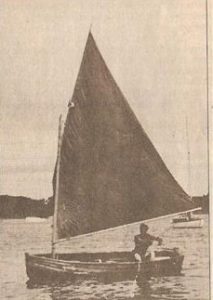
Suffolk – In 1935 Arthur Ransome and his wife moved to Broke Farm near Levington on the Orwell Estuary in Suffolk south of Ipswich taking Coch-y-bonddhu with them. At first he used her as a tender for his new yacht Nancy Blackett, which he kept at Pin Mill on the other side of the estuary from Levington. The yacht was named after one of the Amazon girls in Swallows and Amazons, He also sailed Coch-y-bonndhu on the Orwell Estuary, especially in winter when Nancy Blackett was laid up and in the Walton Backwaters, near Harwich, the setting for his book Secret Waters. Coch-y-bonddhu was lent to George and Josephine Russell, whose parents lived at Broke Hall beside the Orwell for two years. Arthur taught them how to sail.
Lake District Again – Following the outbreak of the second World War Arthur Ransome moved back to Coniston taking Coch-y-bonddhu with him, living on the east side of the lake. He sails Coch-y-bonddhu regularly.
Picts and Martyrs

In 1943 he publishes Picts and Martyrs which features Coch-y-bonddhu in the guise of Scarab.
London – In 1945 Arthur moves to London, sailing Coch-y-bonddhu in the Thames. Three years later he moves back to the Lake District, buying Lowick Hall, south of Coniston Water. However in 1950 he returns to London presumably leaving Coch-y-bonddhu behind.

Earnseat School, Arnside
Around 1954, Coch-y-bonddhu was brought by John Barnes, Headteacher of Earnseat Prep School at Arnside from a boatyard at Bowness-on-Windermere.
Earnseat School was based at Ashmeadow at the end of the Promenade. It was a boarding school for boys aged 8 to 13, It opened in 1900 and closed in 1979. At its peak it had 70 to 80 pupils.
Coch-y-bonddhu returned to Arnside on a coal lorry. The boat is renamed Swallow. John Barnes used Coch-y-bonndhu to teach his eldesr son Edward (Ted) and other Earnseat pupils sailing. The family regard the boat as Edward’s. A favourite time to sail Coch-y-bonddhu was when high tide was in the evening, as it enabled boys to go to bed later than normal
The photo shows Coch-y-bonddhu (Swallow) behind with Kittiwake, a rowing boat in front. John Barnes is the man sat down in the middle of Coch-y-bonddhu. His younger son Peter is standing in the water in front of the boats. The three boys on the boats were the school’s keenest sailors. Richard Blackburn is the boy standing in Kittiwake with an oar. Kittiwake was built by Crossfields for the Barnes family in 1945. Only one person is wearing a buoyancy aid.

Scotland
Coch-y-bonddhu was taken to Scotland probably in 1967 by Jeffrey Parker-Eaton, a member of the staff at Earnseat School, when he got a new job at a Barnado’s Outdoor Centre near Mallaig. The only recorded Barnado’s Centre in the area was at Camusrory at the head of Loch Nevis. This would around the time John Barnes retired as head teacher at Earnseat School, which was December 1968.
Jeffrey Parker-Eaton was employed by Earnseat School to look after the grounds and teach sailing.
Jeffrey Parker-Eaton (1934 – 2012) had a varied career. Born in Birmingham. He learnt to sail when doing National Service on the Great Bitter Lakes on the Suez Canal. At various stages in his life he was a farm manager, hill farmer in Dentdale (his wife left him), racing driver and fisherman. His last job was running a salmon smokery near Lochinver in the North West Highlands. He was known to drive along Scottish single track roads at speeds over 70 mph terrorising locals and tourists alike. He was a member of Arnside Sailing Club.
The Barnado’s Outdoor Centre at Camusrory, which opened in 1967 was in very remote location accessible only by boat or foot. Camusrory is 12 miles by sea from Mallaig the nearest roadhead. Jeffrey Parker sailed there in Coch-y-bonddhu to start his new job. However, perhaps not surprisingly because of its remote location the Centre closed down soon after with Jeffrey Parker-Eaton being made redundant.
Jeffrey brought a motor launch and went into lobster fishing. He sold Coch-y-bonddhu to Henderson’s Boatyard in Mallaig. Coch-y-bonddhu was brought from the boatyard by Charlie McFarlane in 1968 on behalf of his then employer Kenneth Tervis, owner of the Kilcamb Lodge Hotel in Strontian. When Charlie brought Glenfinnian House in 1971 he tried to buy Coch-y-bonddhu from Kenneth Tervis..
Charlie Macfarlane converted Glenfinnian House into a hotel. Normally wearing a kilt, he is well known storyteller, historian, fiddler, composer and piper. His son Iain was a member of Scottish Supergroup “Blazin’ Fiddles.” Glenfinnian on the road from Fort William to Mallaig is where Bonnie Prince Charlie raised his standard in 1745. The viaduct featured in Harry Potter films.
Kilcamb Lodge Hotel in Strontian is located on the shore of Loch Sunart on the road to the Ardnamurchan Peninsula. Strontian has a history of mining. The element Strontium is named after the village,
The hotel was sold onto new owners around 1980. They used Coch-y-bonddhu as a planter for flowers. Charlie Macfarlane attempted to buy the boat around this time to preserve it. When the hotel was sold again in 1991, Coch-y-bonddhu, by now a rotting hulk, passed to the new owners, yachtsman Gordon Blakeway and his brother Peter.

Rediscovery
Coch-y-bonddhu was rediscovered in the hotel garden at Strontian in 1992 by Dr Chris Birt of The Arthur Ransome Society following advice from Jeffrey Parker-Eaton. The hotel owners Gordon and Peter Blakeway donated the boat to The Arthur Ransome Society, who agreed to restore the boat as a lasting tribute to the story-telling skills of Arthur Ransome, An appeal for £4500 was launched.

Restoration
Coch-y-bonddhu was restored by John Hodgson at Fiunary in Morven overlooking the Sound of Mull.
John Hodgson serviced his apprenticeship at Crossfields Boatyard in Arnside, when it was run by John Gill as Crossfields Successors in the late 50s early 60s. It is possible that John worked on Coch-y-bonddhu as an apprentice as the Boatyard maintained Earnseat School’s boats, for example painting them. John’s interest in boats was as a result of reading Arthur Ransome’s books as a child. The BBC Villages by the Sea Programme in 2021 featured an interview with John Hodgson in Crossfield’s Boatshed.
The boat was so distorted that John had to keep her in a cradle over a stream to stop her drying out for two years whilst the boat was squeezed back into shape. Then by soaking the boat’s rotting timber in epoxy he managed to save most of her original planking, seating and mast. Some of the new oak timbers used came from the Lake District close to where Arthur Ransome is buried at Rusland.
Finally the boat was launched at the Kilcomb Hotel at Strontian by Josephine Russell who sailed on Coch-y-bonddhu as a child with Arthur Ransome on the Orwell Estuary south of Ipswich

Post Restoration
Coch-y-bonddhu was kept at Windemere Steamboat Museum from 1995 till the closure of the Museum in 2006
Coch-y-bonddhu took part in Swallows and Amazons Event organised by the OGA in the Walton Backwaters in 1999 and 2001. The Walton Backwaters are on the East Coast south of Harwich. They feature in Arthur Ransome’s book “Secret Water.” The 1999 saw Coch-y-bonddhu reunited with Arthur Ransome’s yacht Nancy Blackett, who she had acted as a tender for in the late 1930s.
In 2005 Cochy-y-bonddhu was sailed by Griff Rhys Jones on Windermere in a BBC documentary about Arthur Ransome. During 2007 she was displayed in the National Maritime Museum in Falmouth.
Between 2008 and 2018 she was on display in the dinning room at Windermere School. Sailing is an important part of the school’s activities.

Windemere Jetty Museum
Since 2019 she has been on display in Windermere Jetty Museum. Also displayed in the Museum are the Swallow and Amazon from the 2016