
Yachts
Wallaroo
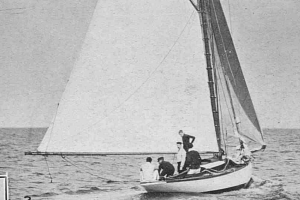
Wallaroo was the first boat to be built in Conwy by John Crossfield after his move from Arnside in 1906, She was one of the leading racing yachts in the North West, winning the Liverpool Isle of Man Midnight Race three times and coming second four times. Her exploits were well reported in the regional press.
Boat statistics
- Built
- 1906
- Length Over All
- 42 ft (12.80 m)
- Beam
- 12.5 ft (3.81 m)
- Draft
- 6 ft (1.83 m)
- Weight
- 25
- Rig
- Gaff Cutter changed to Yawl in 1928
Introduction
Launched on the 19th May 1906, Wallaroo was built for James Spurr, the first Commodore of Blackpool and Fleetwood Yacht Club. He had previously owned Armistice which had built by Crossfield Brothers in Arnside in 1901.
History by Year
-
1906
Built by John Crossfield in Conway
for James Spurr of Manchester
-
1913
Wins Liverpool Isle of Man Race
Having coming second in 1907, 1908, 1910 and 1911
-
1920
Wins Liverpool Isle of Man Race
For second time
-
1927
Brought by William Ashworth
of Hackensall Hall, Knott End.
-
1928
Converted to a Yawl
-
1929
Wins Liverpool Isle of Man Race for a third time
With Mimosa another Crossfield boat coming second
-
1934
Brought by Dr John Reddrop of Barrow
-
May 1934
De-masted in Fleetwood Isle of Man Race
Rescued by Charles Tatham in Zulu
-
Sept 1934
Rescued by Barrow lifeboat
Off south end of Walney Island
Full History
Leading Racing Yacht - James Spurr 1906 - 1924
James Spurr was well known in yacht racing circles. He was also a member of the Royal Mersey Yacht Club, as well being first Commodore of Blackpool and Fleetwood Yacht Club. He lived in Manchester, but was born in the Isle of Man. He had a second home in Blackpool -“The Towers” South Shore. Wallaroo’s home port was Fleetwood.
Under his ownership, Wallaroo won the overnight Liverpool Isle of Man Midnight Race in 1913 and 1920. She came second in 1907, 1908, 1910 and 1911.
Wallaroo took part in 1920 Morecambe Regatta.

Wallaroo, Fleetwood c 1909 (© Sankey Family Photography Collection courtesy of Cumbria Archives image no 1295)
The name -Wallaroo
Wallaroo is an usual name for an English yacht in 1906. There are no other Wallaroos in the Lloyds Register.
Wallaroos are a kangaroo like animal native to Australia and New Guinea. They are intermediate in size between a kangaroo and wallaby.
There was a HMS Wallaroo which left the Australia in January 1906 having been stationed there since 1890. She was named after Wallaroo, the port town in South Australia in the “Little Cornwall” copper mining area. The name of the town Wallaroo originates from an aboriginal phrase rather than being named after the animal.
Perhaps James Spurr named his yacht Wallaroo to signify speed and the return of HMS Wallaroo brought the name to mind.
William Ashworth 1925 - 1934
William Ashworth was a Manchester yarn merchant who leased Hackensall Hall, overlooking the Wyre Estuary south of Knott End.
He and his daughter Gladys took an interest in local affairs. They were Preesall Urban District Councillors, which Knott End was part of.. His daughter was the chairman of the Council in 1933-34. He was chairman in 1934-35. Gladys, his daughter was Preesall’s first female councillor. At one point she was banned from all council committees for making insulting remarks to other members. She was active in the Golf Club.
Nicholas Worsley, who owned Mimosa, another Crossfield’s yacht also lived in Knott End. Like William Ashworth he was in the cotton trade and was active in local politics.
Under William Ashworth’s ownership, Wallaroo won the Liverpool Isle of Man Midnight Race for the third time in 1929, with Nicholas Worsley’s Mimosa coming second.
He was less successful in the Fleetwood Ramsay Isle of Man Race. In 1925 Wallaroo’s main sail split when leading the race.
In 1928 Wallaroo was recorded as a yawl for the first time in Lloyds Register with a mizzen mast and small sail at the aft of the boat.

Wallaroo as a yawl (© Sankey Family Photography Collection courtesy of Cumbria Archives image no 1579)
In 1939 Williamn Ashworth went bankrupt due to the slump in the cotton trade.
1934 -1937 Barrow in Furness - Dr John Reddrop
In 1934 Wallaroo was sold to Dr John Reddrop, the District Medical Officer for Barrow-in-Furness. Wallaroo was moved to Barrow.
I934 was an eventful year for Wallaroo.
In Fleetwood to Isle of Man Race in May, Wallaroo’s mast broke in strong winds when leading the race off the Wyre Light. The Fleetwood lifeboat was called out but was damaged when driven against a post by the tide and had to return to port. Wallaroo was eventually towed into Barrow by Zulu skippered by Alderman Charles Tatham, the Mayor of Blackpool and long serving Secretary of Blackpool and Fleetwood Yacht Club. It took three attempts to get a line to Wallaroo in the rough sea. The race was abandoned. The boat had a crew of 7 at the time.
In September, Wallaroo again needed to be rescued. Returning to Barrow from Glasson in rough seas, the crew could not reduce sail due to problems with a halyard. As the boat was in danger of being driven into the sandbank at south end of Walney Island the anchor was dropped and a flare lit. The flare was spotted by the Coastguard on Walney Island who called out the Roa Island Lifeboat. The lifeboat reached Wallaroo in seven and half minutes, got a line to her on the second attempt and towed her to a safe anchorage of Piel. The crew of 6 were then taken to the Roa Island Lifeboat Station.
Wallaroo is not recorded in Lloyds Register after 1937. Her fate is unknown.
Concluding thoughts
Wallaroo had a large crew of 6 to 8. Were these paid professional sailors or were they amateurs, friends and relatives of the owner? Was a sailing master employed? If so Fleetwood’s fishermen who are sailed for a living would be good source of yacht crew.
Living in Manchester with a second home Blackpool and a yacht in Fleetwood, it would be interesting to know how James Spurr got around. In 1900s cars would have been few and unreliable. Did he have a chauffeur or travel first class by train from Manchester to Blackpool? Did he catch the tram to Fleetwood, or was he taken there by his coachman in a horse drawn cab? The Yacht Club negotiated reduced priced tickets on the tramway for its members.